Stanford WAITS
WAITS was the operating system for the PDP-6 and PDP-10 at the first incarnation of the Stanford AI Laboratory (SAIL), running continuously from 1966 to 1991. Uniquely, its full file system was preserved and a snapshot of the system can be run under emulation.
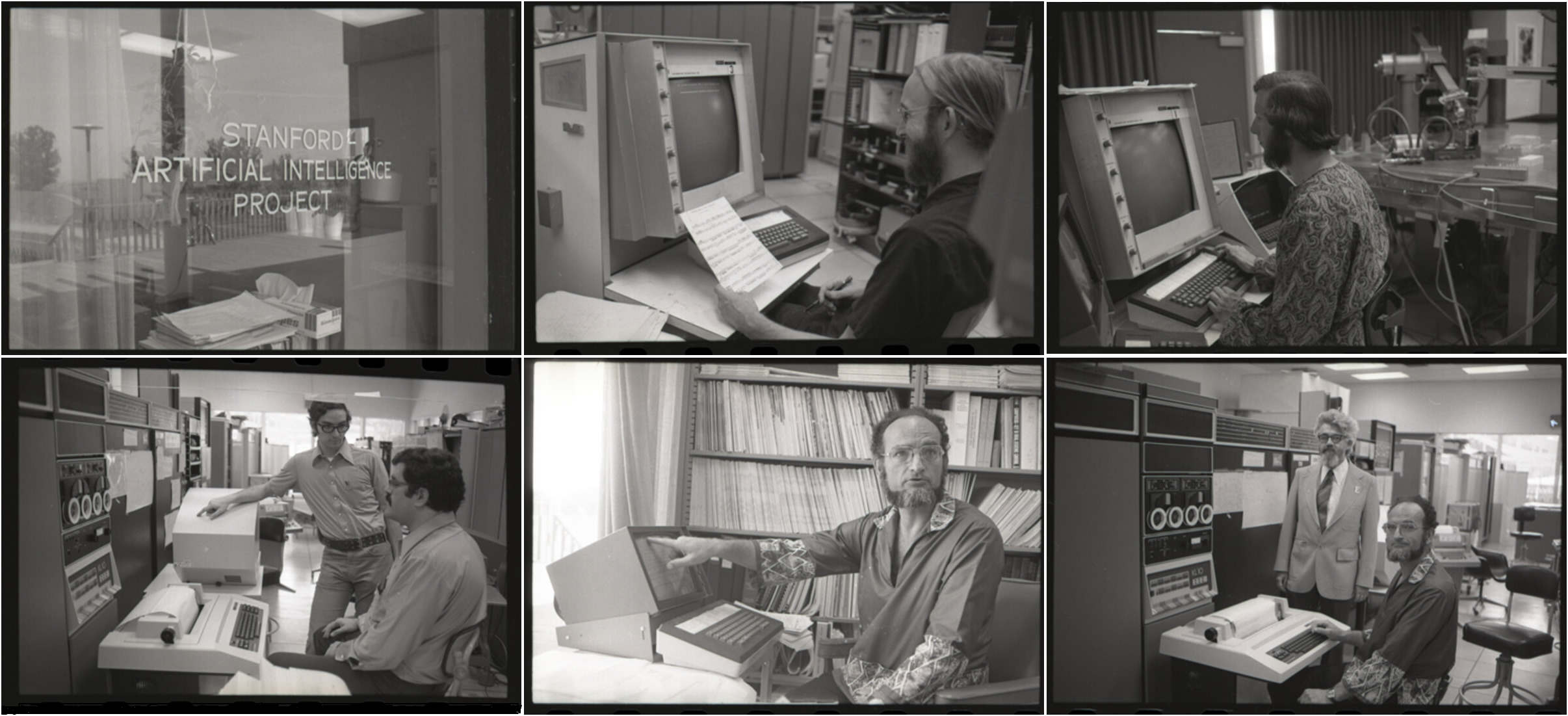 Collage of images from a visit from DEC staff to SAIL, 1976. Source: CHM.
SAIL was founded by John McCarthy in 1963 (before Stanford even had a CS department) with 6 researchers. This grew to 128 people by 1973, by which time the lab had became one of the principal centres for AI research. Work spanned robotics, heuristic programming, NLP and computational theory. Among its alumni were Arthur Samuel, Raj Reddy, Hans Moravec and Alan Kay. Several people not associated with AI also made the lab their home, including Whitfield Diffie, John Chowning and Donald Knuth.
SAIL started out with a PDP-1, for which they implemented a time-sharing system with interactive displays. No traces of this remain, but there is an amusing film about its superiority to batch computing. In 1966, they got a PDP-6. WAITS started off as a version of DEC's Monitor (the forerunner of TOPS-10) but was extensively modified to suit the needs of the lab. It was notable for its support of experimental peripherals - robot arms, autonomous vehicles, display terminals, audio/visual support, and the XGP, one of the first laser printers. Over its lifetime it moved from the PDP-6 to the PDP-10 KA in 1968 and then the KL, added paging (from Tenex) and more memory and disk. As of 1973, it had 256k words of memory, 86M words of disk and 64 display terminals. It was one of the first machines connected to the Arpanet. It was also installed on machines outside of SAIL for a brief time, including at Lawrence Livermore National Labs.
On the software side, most AI research was done in Lisp, but it also spawned its own dialect of Algol called SAIL, and a powerful assembler called FAIL. It had several text editors that made use of its interactive terminals, and had document compilers that could use the XGP, including the first version of TeX.
Incidentally, the name WAITS was adopted several years after the system was introduced, and there are multiple explanations for the name: Western AI Time-sharing System, West coast Alternative to ITS, Worst Acronym for a Time-sharing System, or simply that it waits on you hand and foot.
Preservation status
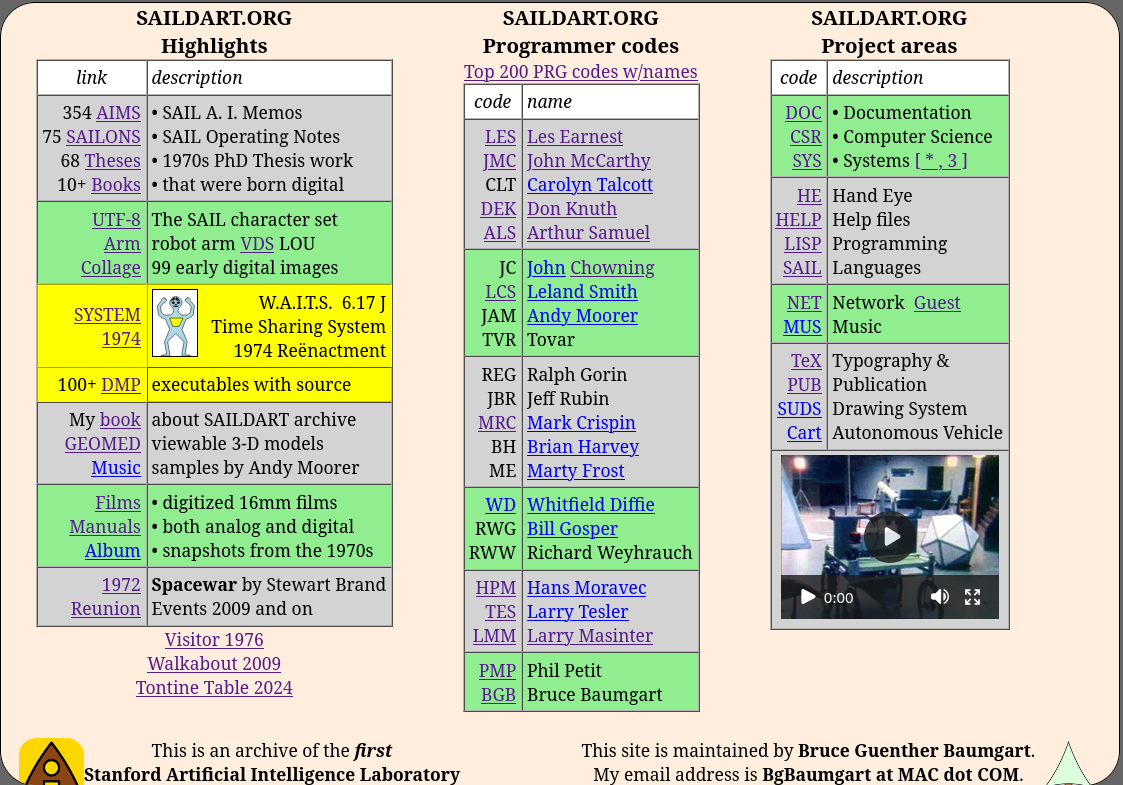 Screenshot of saildart.org. Source: Rupert Lane. License: CC0.
The complete backup tapes for WAITS have been preserved and are available for access. Bruce Guenther Baumgart, who worked at SAIL, was asked by John McCarthy to preserve the tapes produced by the DART archive tool when the system was shut down. He has built an amazing archive site, saildart.org, where you can access files, documents and other information about the system. (Personal files are not publicly available.)
For most operating systems we will look at, we only have the material to install the officially published software. But in this case we have the full file system, so we get to see all the surrounding files that made up a living system. Most of the documentation for WAITS was produced on WAITS, so it is available in its original digital form. Also, as an incremental backup, we can see how files changed over time.
Beyond the file archive, Bruce has produced a snapshot of the system as of July 1974 - representative of the lab's peak activity period - that can be used by emulators.
Emulation status
There are two emulators for WAITS.
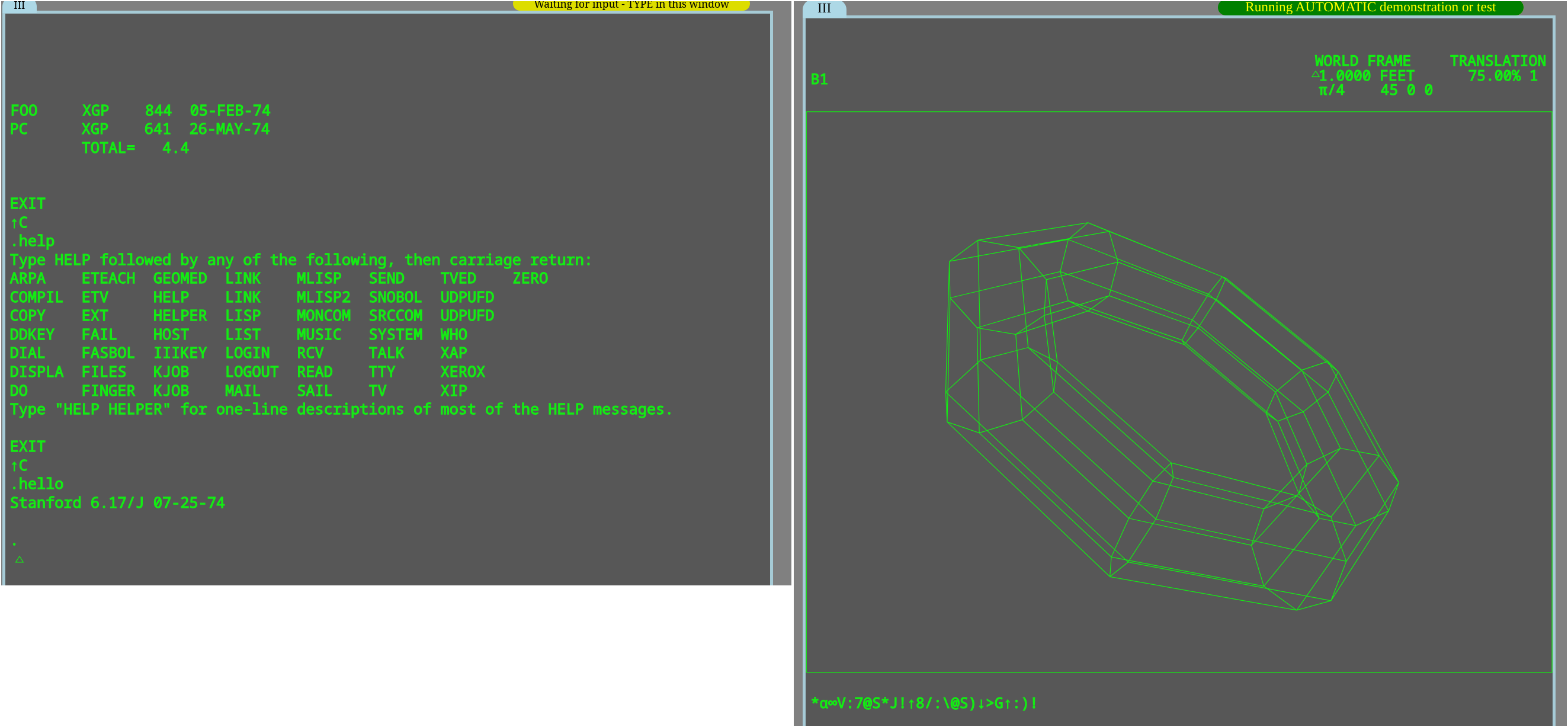 WAITS running on saildart.org's emulator. Source: Rupert Lane. License: CC0.
Bruce has produced an emulator that uses the 1974 snapshot and runs in your web browser at saildart.org. This has demonstrations of a number of interesting systems such as SUDS, the Stanford University Drawing System. It also has interactive access to the complete system using either the console or the III display terminal, so you can login and run commands. Without any additional setup, this allows you to try out the system, but note that your work is not persisted across sessions.
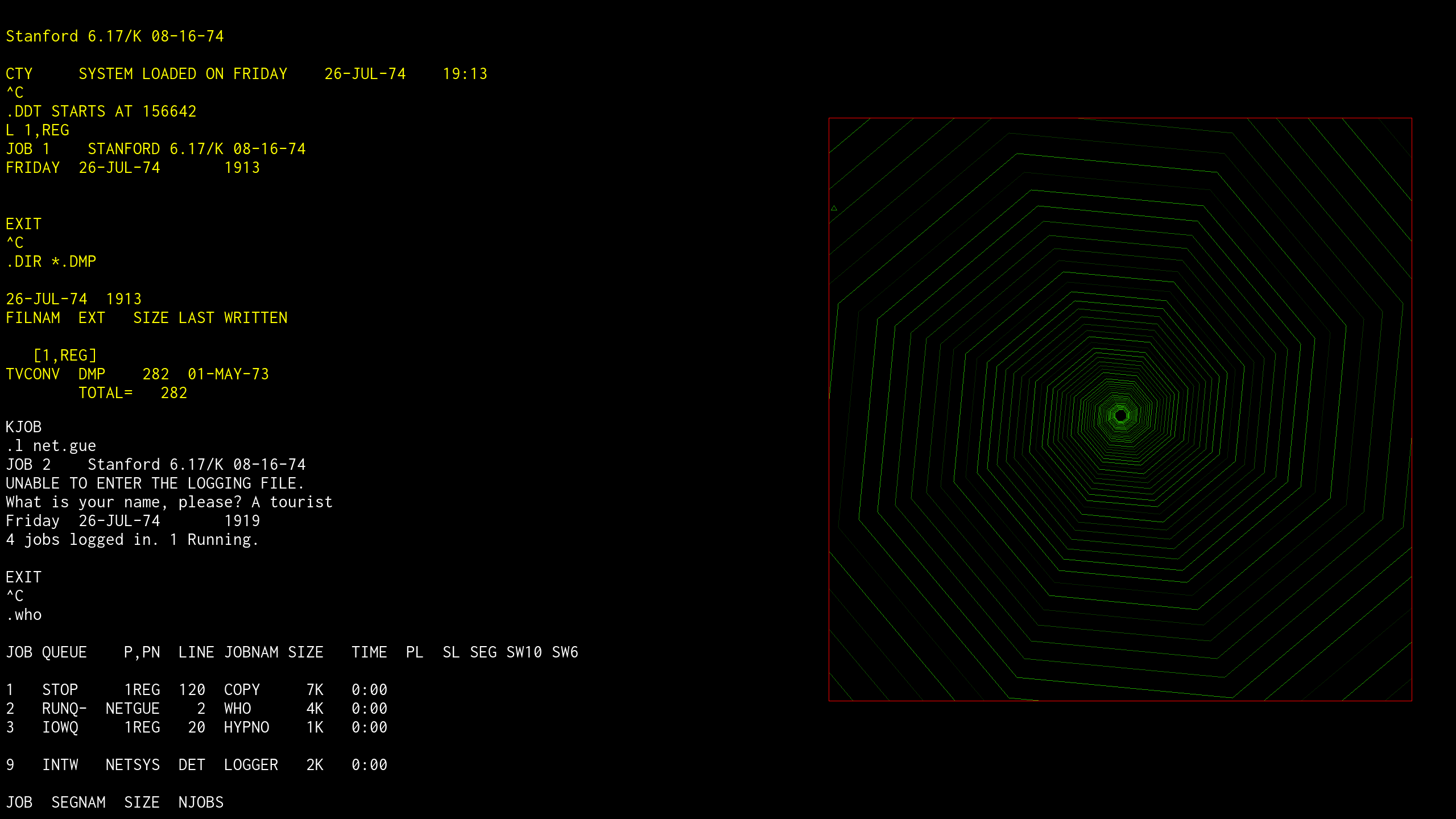 WAITS running on simh. Source: Rupert Lane. License: CC0.
Richard Cornwell has adapted his simh PDP-10 KA emulator to incorporate some of the special hardware used by WAITS, and has provided disk images on his site. The emulator contains support for the III and DD display terminals, along with networking capabilities, which Lars Brinkhoff is currently trying to recreate its Arpanet connection at sailing-on-arpanet. The simh version needs some set up, but does allow you to import/export files and keep your changes over several runs of the system.
One important thing to note: neither emulator has complete coverage of WAITS features, and some programs do not work. This is not due to lack of effort on the part of the authors, rather due to the non-standard nature of the SAIL hardware, which often lacks docs and diagnostics, and the fact this is a snapshot of a running system rather than an official release.
Topics
See the links below for more details on WAITS.
- A quick tour of running WAITS on simh
- Using the terminals
- Files and directories
- Users, jobs and security
- The interactive spell checker
- Text editors
- Getting data in and out of the system
- Arthur Samuel's checkers program
- The XGP, associated fonts and document tools, plus a new emulator that can convert XGP files to PDF.
The main focus of this blog is the operating system and its associated tools, so I will not look in detail at all the user programs available on WAITS. The final update mentions some interesting areas for future study.
Further information
For background information on the PDP-10, see my previous article.
As mentioned, there is a great deal of information on saildart.org. A good place to start is the booklet which gives an overview of SAIL WAITS, and the archive project. The Visitor 1976 gives a photo tour of the lab along with some of its equipment and people.
For more detail, look at the collection of AI Memos and SAIL Operation Notes, or dig further into specialised areas on the main page such as music.
References to files on the SAIL system can be viewed by prepending saildart.org. For example, to read the Lisp manual LISP.WD[S,DOC] you would go to https://www.saildart.org/LISP.WD[S,DOC]
AI Memo 228 gives a good overview of the work done at SAIL in its first 10 years.
Regarding the PDP-1 system that preceded WAITS, the Stanford archive The History of Artificial Intelligence has some interesting material, eg Time Sharing Implementation on the PDP-1 and the User's Guide.
Questions, corrections, comments
June 2026: Added links to more PDP-1 material.
I welcome any questions or comments, and also especially any corrections if I have got something wrong. Please email me at rupert@timereshared.com and I will add it here and update the main text.