DEC PDP-10
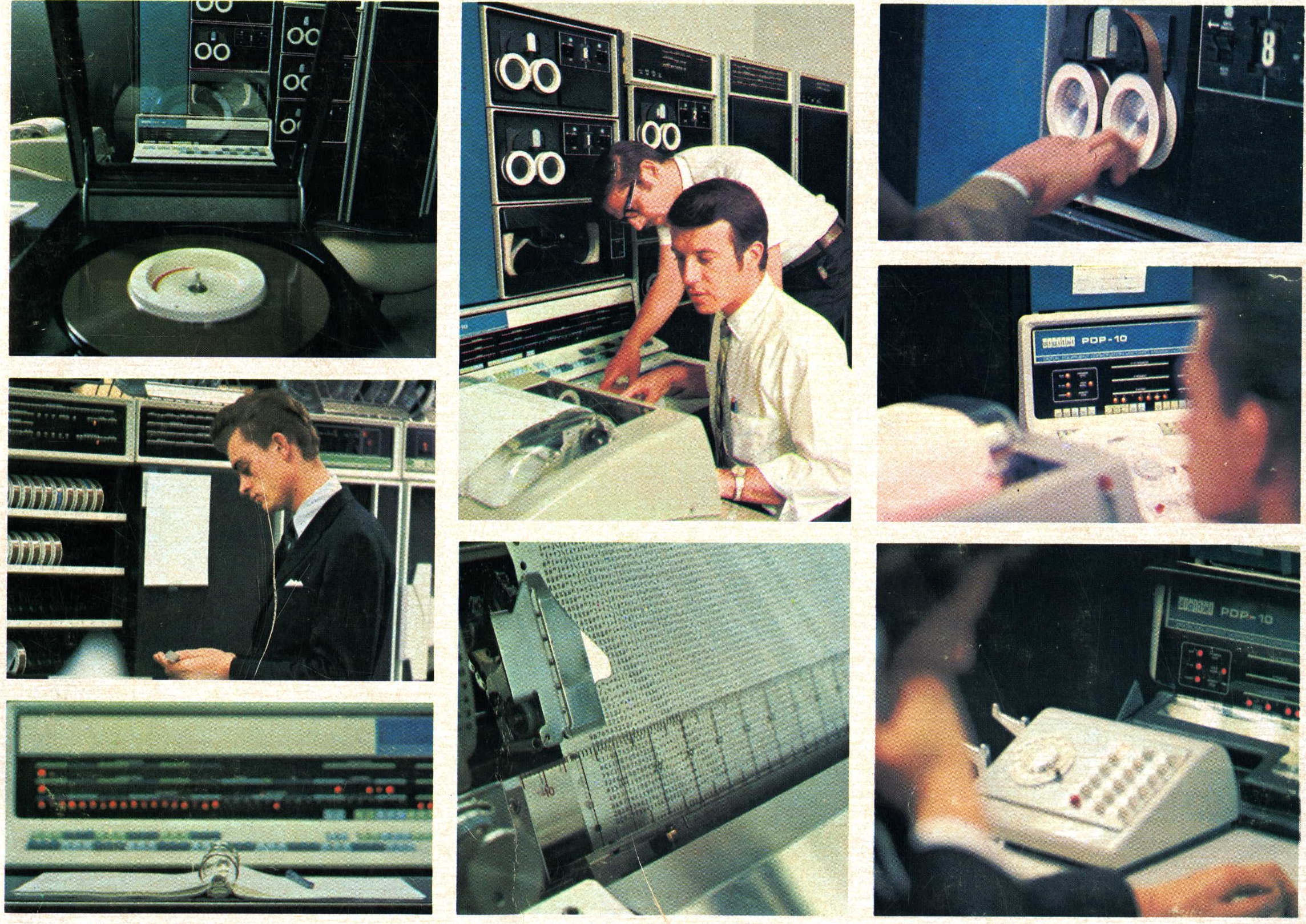 Detail from the cover of the PDP-10 Reference Handbook 1970. Source: Bitsavers
The PDP-10 family of computers (under different names) was manufactured by Digital Equipment Corporation between 1964 and 1983. Designed for time-sharing, batch and real-time systems, these computers were popular with universities, scientific companies and time-sharing bureaux. Several operating systems were available, some from DEC and some built by its users.
It had a large influence on operating system design, artificial intelligence (especially at MIT and Stanford), programming languages (LISP, ML), applications (TeX, Emacs), online communication (ARPANET, Compuserve), games (Advent, Zork) and even helped development of Microsoft's first version of BASIC.
Hardware
The first computer in the family was the PDP-6 which used germanium transistors. It had a 36 bit word, up to 256kW of core memory and ran at approximately 250kHz. It was large (500-700kg), expensive ($300k) and was not very reliable. Only 23 systems were sold, but the architecture was well received by its initial customers such as MIT.
A very similar architecture but advances in digital logic technology and a reliable manufacturing process was used for the PDP-10. Several CPU models were introduced, starting with the KA10 in 1968. This was replaced by the KI10 using TTL and in 1975 by the ECL based KL10. A cheaper variant called the KS10 arrived in 1978. DEC marketed the PDP-10 under the name DECsystem-10 and -20. Xerox PARC and several startups also experimented with clones of the hardware.
During its lifetime, advanced in memory, storage and peripherals were introduced, and there were also multiprocessor variants.
Operating systems
DEC's original operating system for the PDP-6 was called the Monitor and used just 6kwords of memory. This was enhanced and renamed as TOPS-10 (Time-sharing / Total Operating System-10) with the introduction of the KA processor.
Sites would often customise TOPS-10 systems, adding special hardware and facilities to support them in the OS. One notable version was Stanford's WAITS, which evolved to be a separate operating system. The time-sharing bureau Tymshare developed TYMCOM-X based on TOPS-10.
BBN took the KA and added paging hardware which was not compatible with TOPS-10; they built their own system called TENEX. Eventually, DEC brought this in-house and released it as a supported OS called TOPS-20.
MIT, as an early PDP-6 customer for their AI lab, went a completely different direction, developing their own unique operating system called ITS (Incompatible Time-sharing System, a play of words on CTSS.
Preservation status
There's a great collection of PDP-10 software and documentation in the Github PDP-10 organisation, created by Lars Brinkhoff and around 50 other volunteers.
Software kits are available for TOPS-10, TOPS-20, WAITS and ITS: see the above, the trailing-edge collection of tapes, and Richard Cornwell's page.
There is a large amount of documentation on Bitsavers.
Zane Healy's The DEC PDP-10 Emulation Webpage also has a good collection of links to other PDP-10 sites, some of which you may need to use the Wayback Machine to access.
Emulation status
Probably the most comprehensive suite of emulators is Richard Cornwell's simh-based emulators for the PDP-6 and the KA/KI/KL/KS model PDP-10s. This had been merged into opensimh.
Also of note is Ken Harrenstein's KLH10 for the KS10 and KL10, and Bob Supnik's original KS10 emulator for simh.
The PiDP-10 recreates in hardware the PDP-10's front panel connected to a Raspberry Pi running simh. A lot of MIT AI Lab hardware is also demonstratable using this project.
The Interim Computer Museum holds a collection of PDP-10s formerly
exhibited at Seattle's Living Computer Museum. Many of these systems,
along with some emulators, are available online at ssh
menu@tty.sdf.org:.
Coverage on this site
I plan to cover each of the below available operating systems, though probably not all immediately. When a system is added, click the links below to find out more.
- TOPS-10
- WAITS
- ITS
- TOPS-20
Further reading
Wikipedia's page for the PDP-10 is a good place to start.
Gordon Bell, who was an architect at DEC for the PDP-6 and other systems, wrote a paper The Evolution of the DECsystem 10 which gives a great overview of the system's hardware and software, along with its impact.
Questions, corrections, comments
I welcome any questions or comments, and also especially any corrections if I have got something wrong. Please email me at rupert@timereshared.com and I will add it here and update the main text.