The IBM System/360
As the 1960s started, IBM was the leading supplier of computers in the US, but problems were building. It had five different machine architectures, from simple commercial machines like the 1401 to powerful scientific models like the 701, but all were incompatible with each other. This made it expensive for IBM to maintain peripherals and software, and customers did not have an easy upgrade path. Most applications were written in assembly language and a change of machine meant a rewrite - making it more likely a customer would consider other computer manufacturers rather than staying with IBM.
IBM's solution was the System/360, announced in April 1964. This had a single logical architecture with implementations over six processor models, offering a 50-fold range of performance. It was designed to support the same software and peripherals across all model types, and used new electronics techniques such as Solid Logic Technology.
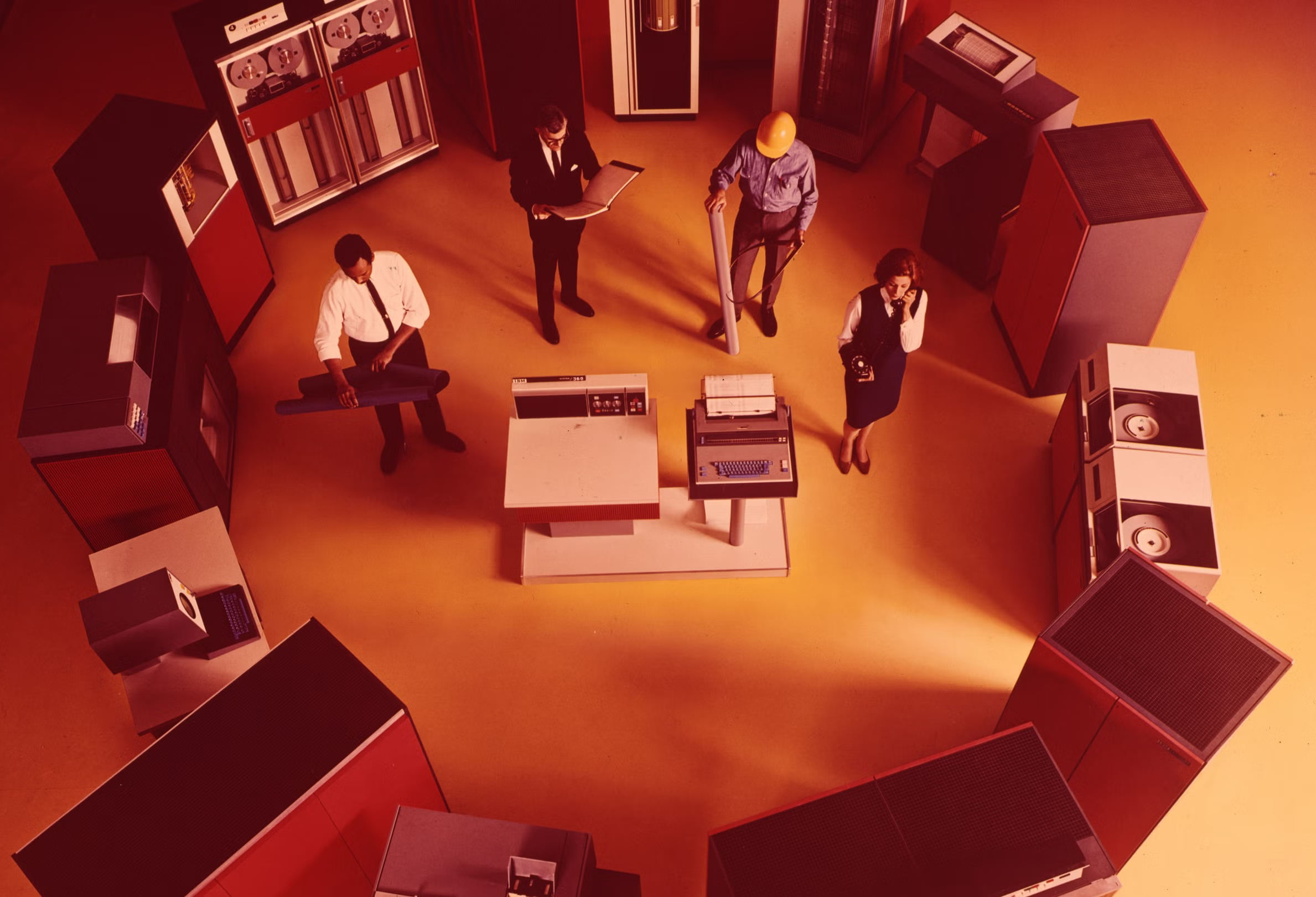 The IBM System/360. Source: IBM promotional brochure.
Over 1,000 orders were received in the first four weeks after its announcement, and although it took several years to resolve problems in hardware and software, the architecture went on to become the dominant mainframe system.
Several upgrades - System/370, System/390 - were introduced over the years and IBM still sells these machines today under the 'z' brand. System/360 architecture mainframes were produced by other companies, including RCA and Fujitsu, and were even cloned by the Soviets. Mainframes continue to be the backbone of many commercial and financial systems around the world, and with very few changes, code from the System/360 can be run on today's machines.
Hardware
The System/360 had a 32 bit architecture with 24 bit addressing and 8 bit bytes, using EBCDIC for character encoding. The smallest standard machine came with 8KB of core memory and the most powerful could address up to 8MB. Larger machines could transfer more data at once, and would have facilities like floating point implemented in hardware. Only the System/360 model 67 had support for dynamic address translation needed for efficient and secure time-sharing, but these facilities became standard in later iterations such as the System/370.
Machines were generally rented rather than purchased by customers, allowing easy upgrades. Monthly costs were "from $2,700 for a basic configuration to $115,000 for a typical large multisystem configuration". (Multiply that by 10 to get a rough idea of what this would cost in 2026 dollars).
Software
IBM announced a unified operating system called OS/360 at the launch of System/360, but despite a great deal of effort (made famous in The Mythical Man-month, written by Fredrick Brooks who was a manager on the project), it could not create something that would work on the entire range of models. Simpler systems, such as TOS/360 (Tape Operating System) and DOS/360 (Disk Operating System, not related to the IBM PC DOS) were launched first, and several iterations of a multi-processing disk based batch system were introduced, including MVT (Multiprogramming with a Variable number of Tasks) which would become MVS (Multiple Virtual Storage) on the System/370.
The original plans for system software did not include time-sharing (to be fair, CTSS and Dartmouth DTSS were only just starting to be developed when IBM designed System/360). Demand from several customers in the mid-1960s led to TSS/360 (Time Sharing System) being made, but it was not a great success.
A different approach was taken by IBM's Cambridge Scientific Center, which created a virtualised operating system hypervisor (called CP) that could run multiples copies of a single user system (CMS) independently, and later other operating systems. This CP/CMS system became known as VM/370 on the System/370 and was popular as another approach to time-sharing. It is still available from IBM today as z/VM.
Work continued on the batch operating system MVS, and TSO - the Time Sharing Option - was created as a shell on top of the system to allow multiple users to access the machine interactively. This was probably the most widespread multi-user interactive system on System/360 hardware. MVS is supported by IBM today under the name z/OS.
IBM created many more operating systems - see the Wikipedia article History of IBM mainframe operating systems for full details.
Several universities, frustrated by the delays in IBM's development of time-sharing, produced their own operating systems, notably the University of Michigan's MTS (Michigan Terminal System) and McGill's MUSIC/SP (Multi-User System for Interactive Computing/System Product).
Edinburgh University created a version of their EMAS operating system for a System/360 compatible machine. Stanford built a system on top of MVS called ORVYL that was roughly comparable with TSO.
The Linux kernel has also been ported to the System/390 and several popular distributions are available, eg Debian.
Preservation status
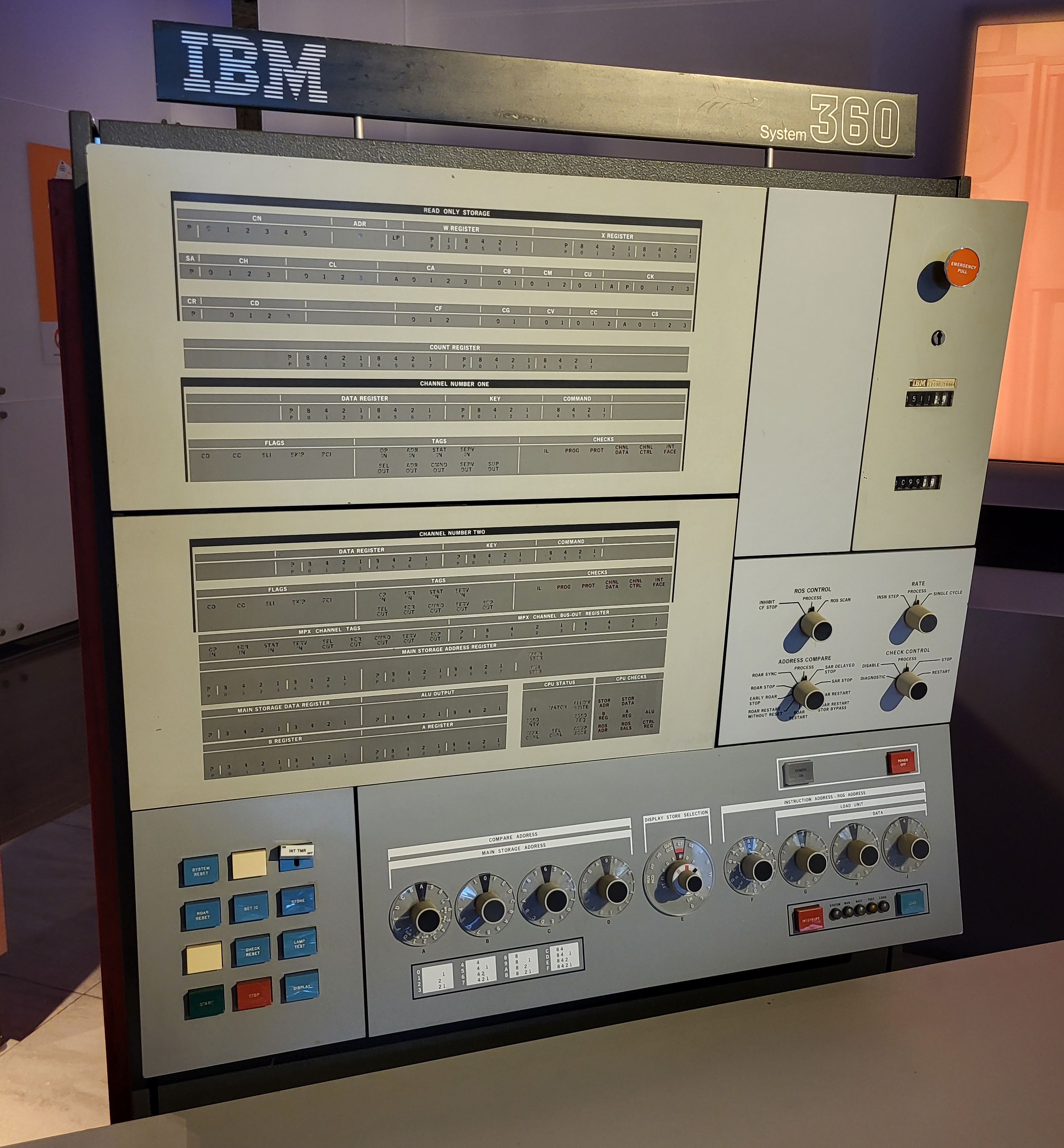 System/360 front panel on display at the Computer History Museum. Source: Rupert Lane. License: CC0.
Prior to 1969, IBM bundled operating systems (often including source code) with its hardware and did not assert copyright. This has allowed distribution of early versions of MVS, VM and TSS. In some cases, hobbyists have taken these old versions and added modern facilities, such as Volker Bandke's Turnkey MVS and the VM/370 Community Edition.
MTS, MUSIC/SP and ORVYL are freely available, as of course is Linux. There is currently work being done to get EMAS running again; see the Github repo here.
Bitsavers has a large collection of IBM hardware and software documentation.
Several real System/360s have been preserved in museums, including the Computer History Museum in California and the Science Museum in London.
Emulation status
The most widely developed and used emulator is Hercules, which includes support for classic System/360 and later variants, along with networking and peripherals. Several forks are available, with the best supported today being SDL Hercules 4, whose source is on Github. Jay Moseley's introduction page is a good guide to what can be done with Hercules.
Richard Cornwell has written an emulator for the System/360 and /370 under simh that can run many early operating systems. Roberto Sancho Villa's simh_cpanel project adds graphical front ends and a distribution of VM/370 plus batch operating systems. Richard is also working on a microcode level simulation of the System/360 with a very detailed front panel.
Also of interest is Ken Shirriff's browser based IBM 360/50 Simulator that shows how the front panel looks when executing code, along with what is happening internally.
On this blog
I plan to cover these operating systems in more detail. Links will be added as I come to them.
- IBM TSS/360
- IBM CP/CMS (VM/370)
- IBM MVS with TSO
- Michigan MTS
- McGill MUSIC/SP
Further reading
Emerson Pugh's book IBM's 360 and early 370 systems goes into great detail on the history of this computer, including chapters on peripherals and software. You can read it online at the Internet Archive. A summary, also by Pugh, can be found at the Engineering and Technology History Wiki.
The Computer History Museum has a virtual exhibit on the System/360, and a real front panel on display in the museum (see the picture above).
IBM's System/360 Principles Of Operation is a clear overview of the system's architecture and can be found at Bitsavers.
Questions, corrections, comments
I welcome any questions or comments, and also especially any corrections if I have got something wrong. Please email me at rupert@timereshared.com and I will add it here and update the main text.